
made with
He interviewed as a student. They asked him to teach.
September 9, 2021
By Siobhan Stewart
Johnny Ganta: Maximal Surrealist
Interviewer: Thank you for joining me, and could you just tell me a little bit about who you are, where you live, where you’re from, what type of art you do? Sorry that was a lot of questions
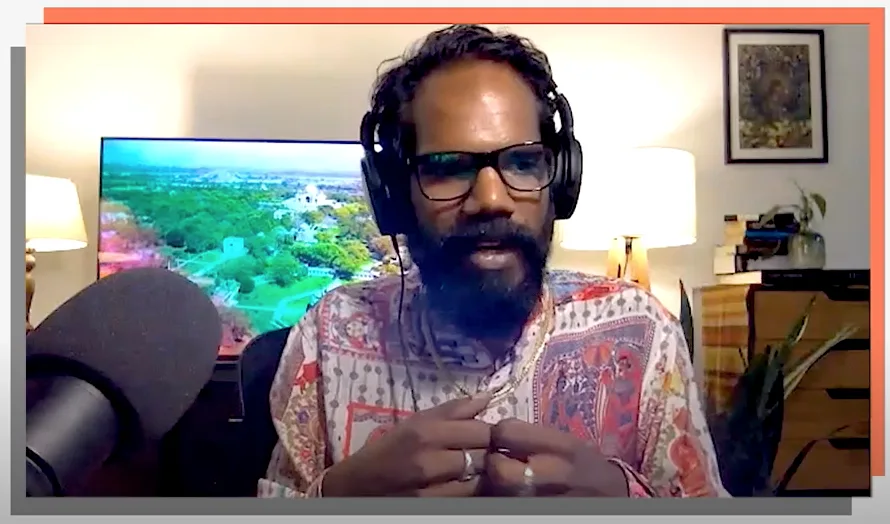
Johnny Ganta: My name is Johnny Ganta, I know that on this recording it says John Crucible, but there’s a story behind that – it’s a moniker. But my artist’s name is Johnny Ganta and I’m a maximal surrealist.
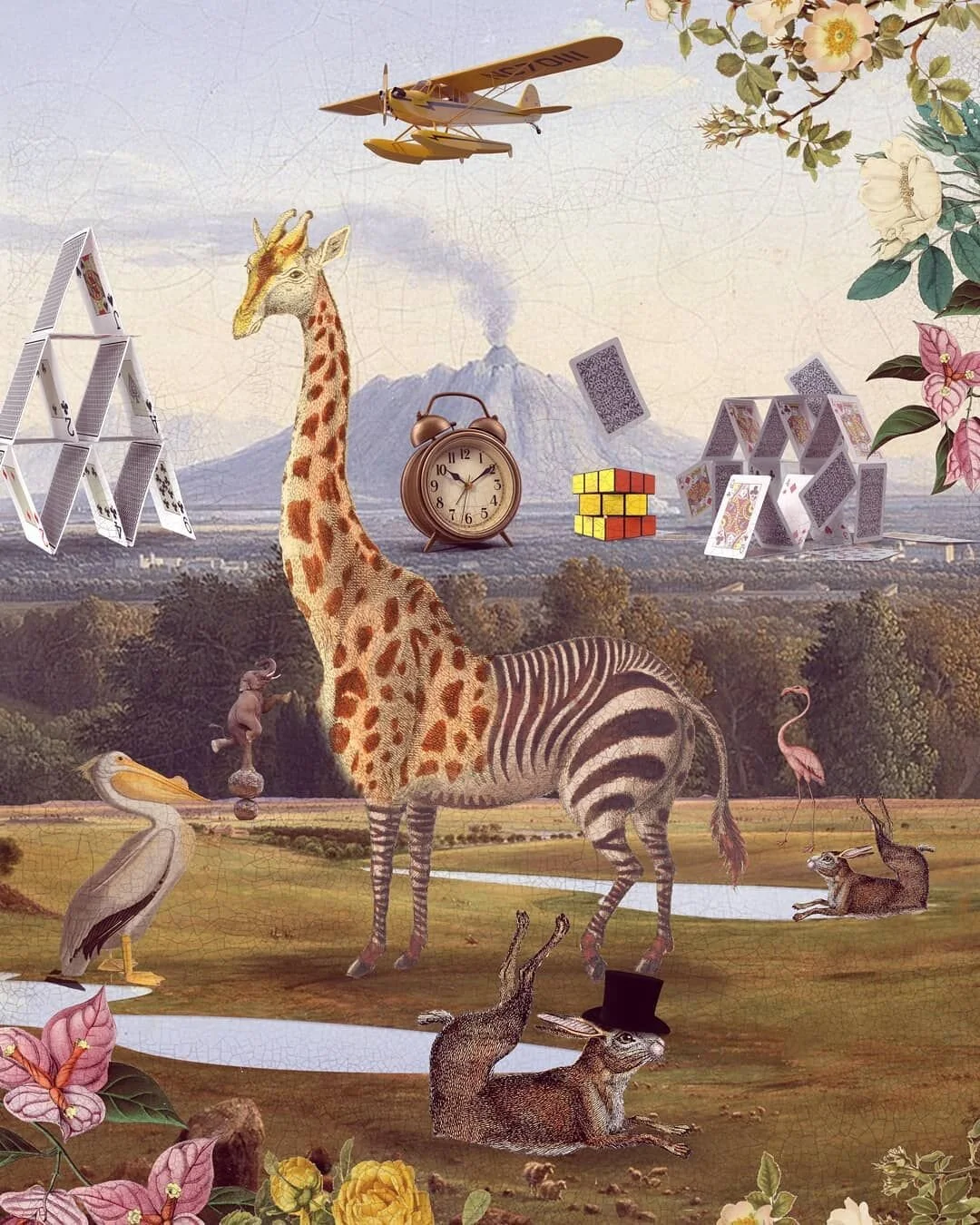
I do a lot of compositing and this kind of artwork is used in game design, it’s used in…artwork like that on the wall over there. And I also teach. So I teach at one of the biggest design schools in India. And this is in Bangalore and Bangalore is known for being the Silicon Valley of the subcontinent. It’s great being here.
Interviewer: I wanted to ask you about imposter syndrome, if you’ve ever experienced it and if you have any advice.
Johnny Ganta: I never studied design and you know when I was in high school I always thought that, well you know I was that kid that kind of made fun of the artists. It wasn’t until I started my undergraduate studies at Hope College that I started, you know, exploring sort of the fine arts by way of film and music.
My whole first year was all about music, and then I segued into film and I suppose that kind of constitutes some sort of design thinking sensibility to some degree, but I never really practiced what I had studied. I wasn’t a practitioner in my craft as yet.
Soon after I graduated, I moved into the corporate world and I was just doing desk stuff. I was working at Comcast and Time Warner and some of those people in New York and it wasn’t artistic in any way, but it was business and when I moved to Dubai soon after, that was my first foray into design.
Selling Classic Cars in Dubai
But this was as a stationer – I actually started out this company called the Raizuli and you know I was doing my MBA at the time and I was working with some of my friends in that program and we wanted to start a business and in Dubai at the time, it was just classic cars, right, and so I guess we started out as used car salesmen.
That was our first hustle that was the first like, “Oh do we really – are we really doing this?” I mean we would go to trade shows with just business cards that would just say Raizuli Motors just so that we could just get contacts, and you know just learn about the whole industry, because we had no idea…
Yeah we were we were fools in many ways, but blissful fools because had we known any better we probably would have never done that. But because we did that, it kind of gave us a sense of “Okay you can create an identity, that’s branding, then you step out, then you network, and then you make things happen.”

Designs from The Raizuli.
At least that’s what we thought, but then it wasn’t until people started complimenting us on business cards that everything changed. We left the whole classic car game and moved into identity and design. It all just began with the business card, and we had this tagline: “Stationers for Kings” on the business card. That kind of, you know it, it, manifested itself in reality. It was so weird, we started working with some of the royal families in the Emirates and then just, yeah, just things took off from that.
I learned a lot about design and that’s when I moved away from print and into the digital space and I started focusing all of my energy on just what can we do with a computer what can I do with just my laptop and so that’s when I switched from illustrator to photoshop and once I got into photoshop I started compositing collaging and all that stuff and um and now I just I kind of prime my primary tools are photoshop and after effects for most of what I do and then of course if i’m doing 3d stuff I will work with a separate team and kind of like art direct is what I do at times and I’m learning 3D now, I’m a constant learner…so that’s my evolution, yeah I’m still evolving.
Everyone is an Imposter
Interviewer: I think for me Imposter Syndrome is sort of almost this sense of self-doubt, or just kind of looking around you and wondering if you deserve where you’ve gotten, right? And also a sense of: “Are people going to find out that I am kind of faking my way here or have faked my way here or don’t really know what I’m doing.
Johnny Ganta: Everyone is an imposter, right? In some sense think about it – I mean from the moment we’re born, we’re looking at adults and they’re living in their adult world and the child doesn’t really have – you don’t understand why these adults are doing what they’re doing.
Why are they sitting around the table drinking funny drinks that taste awful and why are they talking about boring things? I mean why aren’t they like playing with the mud and, you know, running around outside? So you grow up thinking well if that’s what adulting is, then I don’t feel like I’m doing it, and you will carry this.
Believe it or not, even adults carry this throughout their entire life and either you’re aware of it consciously but, the truth is most people just they’re not conscious of this. They’re not conscious of the fact that they have this sort of self-doubt that’s sort of underlying everything that they’re doing.
One thing I can say is that it can motivate you. If you feel like you’re insufficient, if you feel like you’re not quite there that is – if you surround yourself with people that are just a little ahead of you in skill level or something like that, that’s a good way to kind of take Imposter Syndrome and use it to your advantage.
You have to trick yourself; you have to somehow make use of these – what could be debilitating, you have to make it work for you.So I say get into a position where your level of challenge is just more than what you can handle. You will feel like an imposter but it’s also going to push you to do a little more research, you know just work a little harder, like get on Skillshare, learn a few more skills or something.
Starting as “The Fool”
Johnny (pulls out Tarot decks): Okay, they are known as tarot decks but I appreciate them to be art. One of the things that I found out as I started exploring tarot was the way these cards are laid out right now this one is Ethereal Visions by Matt Hughes: beautiful deck, beautiful prince and the first card that you’ll find in any of these decks is this one, okay – what is this – it’s the Fool. Right, do you see that, right?
So it’s this dude that’s sort of, you know, stepping out; there’s a ledge in front of him but he’s this blissful fool and this is your first card, like your journey doesn’t begin unless you’re willing to be this person, right? and if you’re familiar with some of Jordan Peterson’s work, he often says that it is the fool.
You need to be a fool if you want to be a master. You have to be willing to be a fool; you’re kind of doing improv, and that improv is kind of like b**ing your way through a situation, and that can be very intimidating, but it’s also good because if you get the sense that you’re b**ing, it should prompt you to go back and: “Well where did I feel like I was just gassing my way through this?” and you sort of find the information that you need to to fortify what it is that you’re trying to present in the first place.
Alter Egos Allow Artists to Explore
Johnny Ganta: Who’s John Crucible? It’s a moniker right? It’s a moniker which allows me to play a role where I don’t have to feel bound by some predetermined definition of what it is that I’m supposed to perform as, or who it is I’m supposed to perform as. I can craft my own definition: this is what an alter ego is all about, right? And so artists, I encourage artists to develop alter egos – in fact I everyone’s an artist, okay?
You’re an artist, everyone’s an artist, develop an alter ego and start talking. Like start talking about the stuff that you maybe wouldn’t have a platform or an avenue to talk about otherwise, you know, and now is that, is it fake? No not at all it’s being creative, and any creative practitioner, the more you start doing and the more you define yourself.
Like you know James Clear wrote this book, Atomic Habits, and it’s very popular right now. You’ve got to wonder: “Why is such a book so popular? A book about habits. How is it a New York Times bestseller just like that? How is it that young people and old people who are supposed to have all of their stuff together – how’s everyone interested in this kind of a book?” Right, and it tells you something.
We’re not perfect, right? Everyone has warts, but we don’t see this in our virtual world, right? We have a facade. This what I’m wearing right now, it’s a facade, right? But we’re allowed to wear facades.
Interviewer: I know you started teaching without a background in teaching, or necessarily teacher training: Did you feel like you had to do that personally? Like you had to think…?
Johnny Ganta: Oh my god, yeah, yeah when I started teaching, I got really – it was the weirdest thing. I had Imposter Syndrome like, wow, okay yeah we gotta get into this one. So I did my MBA and my focus was finance, right? and I had this – I was an entrepreneur of sorts with the Raizuli, you know that, but how, my god, my mind for the next four years, I mean since I came when I moved to India in 2014, I still felt like such a fraud.
I mean for one thing people didn’t know who I was when I got here, right, so I was, I kind of had to create a persona and identity and just live into it. Then I started creating this art, right? and it caught on, people liked it. Culture Shop signed me, and I got a few other art commissions from a few different people.
Some publications, magazines decided to call me up to do a little bit of an interview and figure out “Who’s this guy, and how is he coming up with this stuff? And did he ever study art?” and all that and these questions are coming up. I used to get so scared, you know, because I get the list of questions in advance and I’m like “Oh my god, what am I gonna say? This is so scary, they’re gonna know that I just use the computer to do everything man, like I don’t even know how to draw very well,” right?
It was only later when I discovered okay, I can still call myself an illustrator because I just didn’t understand what the word illustrator was until I started teaching about illustration.
He applied as a student. They asked him to teach
Now how did I get into teaching? Well I wanted to get another degree first. I wanted to get another Master’s degree in visual communications or something like that. I felt like without the degree I couldn’t be an authority and talk about the subject and so I applied to this program here in Bangalore at Srishti.
I applied as a student, but then when they saw my portfolio and everything, the conversation kind of went in another direction. I was almost as though, see, I didn’t know that I had accomplished everything that needed to be accomplished if you’re going to be a person with a master’s degree at that level.
I’ve already accomplished that and so not knowing that, I’m hearing from these people that I’m really intimidated by – I mean in this interview,and they’re saying: “Well we don’t know if this is going to be the best course for you, and we’re going to be just absolutely honest, you’ve already done enough stuff, so why do you really want to do this?
I was like whoa, okay so I’m maybe overqualified for the course, this is good. So when I was in that interview, the words slipped out of my mouth: “What about teaching?” I just threw it in there, and then immediately they were like, “Yeah, well this is something that we actually discussed amongst ourselves… and then the conversation went down that path, and before I knew it I was on board with the teaching faculty at the university, and the rest is history. Now the first class I taught, I was so scared,I was like, “Oh my god,” I felt like the imposter.
I remember when we had this round table discussion – this is just with faculty, new faculty, and they’re introducing themselves and it’s going around the room and these are all the visual communication and strategic branding faculty, and I’m so intimidated because I’m surrounded by teachers again, and I’m like in my mind, I’m thinking: “I came here to learn, not teach.”
But as everything was going around the room, and everyone was just saying what they did, I just kind of that’s when, yeah I felt like the biggest imposter ever. Later my director told me – when I asked her how am I gonna teach one of the classes that I was gonna teach? I was gonna teach illustration for communications and I had never taught the class. I mean, I illustrate, but I didn’t – I’ve never taught it and I said: “How am I going to teach this class? She said: “Look, you’ve got to teach them what you know. Just teach them what you know,” and so that’s when I realized: “Oh my god, teaching is first discovering your process, making sense of it, and now explaining it to people.”

Using Education to Overcome Imposter Syndrome
Interviewer: It sounds like also some of what you’ve been saying is that education is a big piece of kind of approaching or dealing with imposter syndrome, like you feel like an imposter but you can teach yourself and learn and learn from people around you but learn, you know in other ways, and overcome it in that way.
Johnny Ganta: I mean you only need to be five minutes more-read on a subject than everyone in the room in order for you to be the expert. Here’s the thing: I think a lot of people feel like imposters because we live in a world of extroverts, especially America.
Okay it’s like you get on Clubhouse and everyone sounds like they know what they’re talking about, right, but you don’t know what notes they’re like referring to on the side. You know what I’m saying; you don’t know what’s actually going on behind the scenes.
A good extrovert is a good jargonist as well, good b**r right? That says there’s an art to that, they feel like imposters too, right, but if you’re a strong introvert you’re gonna be like: “Dude I can’t compete in this game, I don’t feel good enough, I don’t have that kind of eloquence, and those words – I can’t just gass my way out of a situation.”
Interviewer: There’s that quote of not comparing your Behind the Scenes footage to someone else’s Highlight Reel.
Johnny Ganta: Yeah, what do you mean by that?
Interviewer: Though you know, like, what you see around you on social media or you know even day-to-day life is like the polished – like you said – maybe “extroverted version” of people’s selves so that’s like they’re highlighted their highlight reel like these are all right right it is for them in their life or whatever and you’re comparing it to you and your Day-to-day your behind-the-scenes footage
Johnny Ganta: When I ask my students what your favorite Leonardo Dicaprio film is, 60% of them will say Catch Me if You Can. I find this fascinating because it’s a movie about a con artist, sort of an imposter really, but if you think about it, what’s appealing about the con artist and con artistry?
I just, I want to leave you with that thought: It’s a very popular film, a lot of young people like it. I know it was one of my favorite films growing up, but there you have it. I just want to leave you with that.
Interviewer: Do you think that appeal is that it speaks to something in all of us it really does yeah and it makes us feel Like if he can do it then I can do it maybe you know
Interviewer: Not in the most ethical way.
Johnny Ganta: Not in the most ethical way. I mean it’s a movie, though, but and it does speak to the psychology – our inner psychology – though we do feel like imposters and we do want to overcome this imposter feeling by, yeah, faking it until you make it, which is kind of what he did every time.
Interviewer: Thank you, thank you so much for talking to me.
Johnny: Thank you Siobhan, this was wonderful.