
made with
How this Artist uses Imposter Syndrome to Fuel his Art
September 7, 2021
By Siobhan Stewart
Daniel Zeller got his BFA and MFA in sculpting, but in NYC he started pursuing a different artform: detailed ink sketches that are honestly mind boggling. Watch and learn more about his journey, his process, and how Imposter Syndrome affects artists.
Daniel Zeller: Microscopic & Aerial Drawings
Interviewer: Could you introduce yourself, and tell me a little bit about who you are and your artwork?
Daniel Zeller: Sure. My name is Daniel Zeller, I have been making art probably my whole life. I have always drawn, so as a kid I was always drawing in my notebooks and doodling and that kind of thing, and in college I studied sculpture. I got a BFA from the University of Connecticut and an MFA from the University of Massachusetts, both in sculpture, and I also continued drawing throughout that time.
I never thought of drawing as something that was a career. I would focus on it, and I was very interested in building things and making things. Moving to New York space became an issue, and storage and all that stuff so I, for that reason, focused more on drawing.
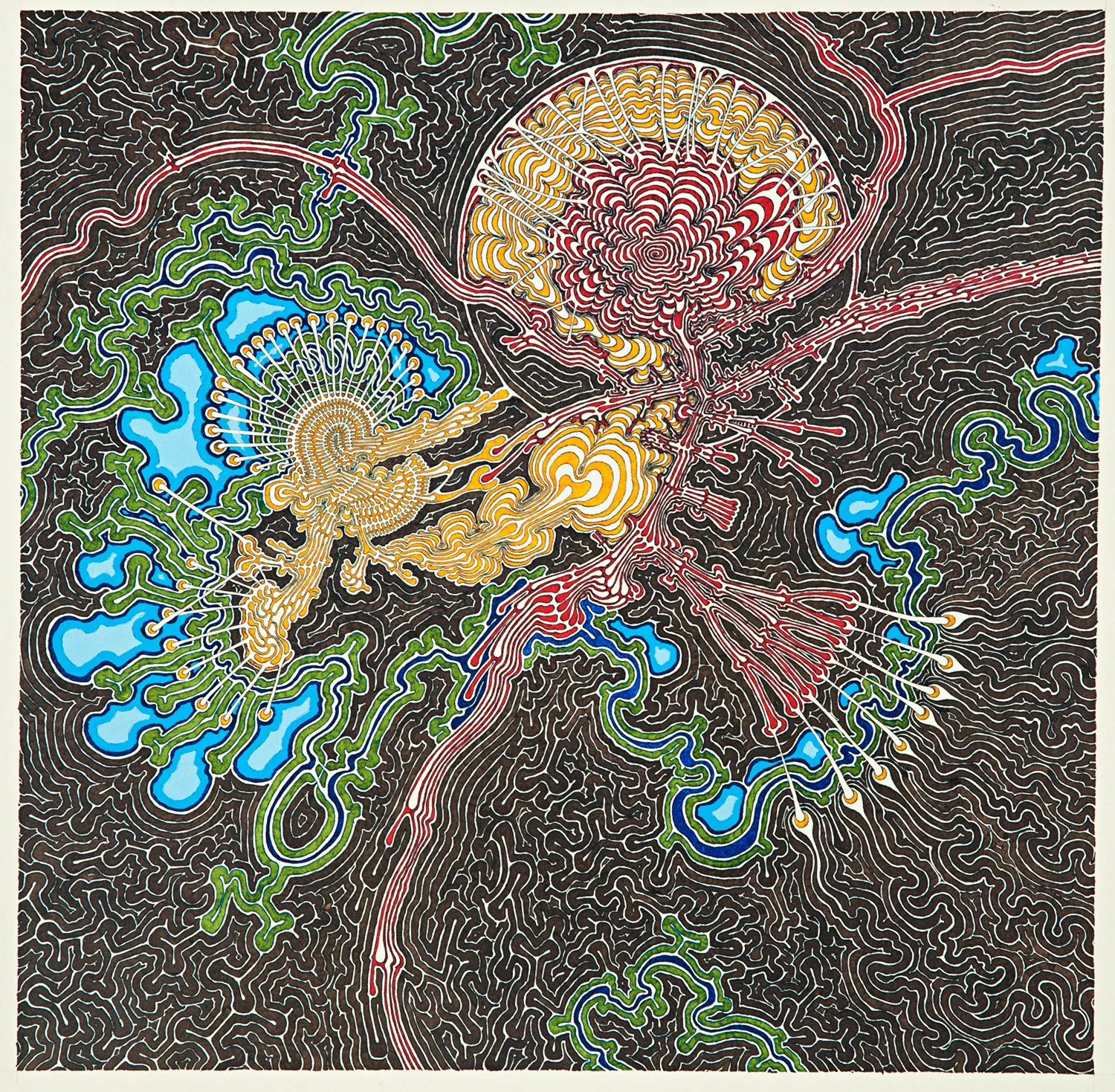
I was able to work for a couple hours after a job so it was easier to generate ideas and keep things going quickly. The drawings I do are labor-intensive and very methodical relating to a lot of maps and satellite imagery that I look at, and microscopic imagery as well as all kinds of scientific images and schematic diagrams. It’s kind of in the mix of where my sources come from.
I’ve always had a broad interest in many different things. In order to focus on one thing, I pull it all together and build these. I think of them either as environments, like an aerial view of a landscape or of a very small microscape. There’s an interplay between those two ideas. I’m really inventing using the languages of those sources. I’m inventing my own kind of world in a way, if that makes any sense at all.
Interviewer: Yeah that makes a lot of sense and it’s interesting that you talked about world creating because some of your works that I was looking at kind of reminded me of the map pieces that you’re talking about, they remind me of sci-fi books and fantasy, when you open those up and see the images and they have that otherworldly thing where it’s based in our world but you make it your own or see it through a different lens.
Dan’s Artistic Process
Interviewer: I wanted to ask you a little bit about your process – what are the tools you work with and how long does it take to make these?
Daniel Zeller: I work on various scales. I work pretty large sometimes. I usually have a couple of pretty large pieces working and a whole stack of smaller ones going and I’ll pick through and work on whichever one fits my mood or the one I’m focused on at that time. If I’m stuck on something, I’ll put it away for a while and go back to something else but I work on paper almost exclusively.
I do some work with pencil with graphite and mostly now I’m working with ink and I work with technical pens that are the devices that architects and drafts people used to use before computers took over. If you’re not familiar with them, they’re very temperamental and you have to maintain them very carefully. They have a pretty sharp needle point and you have to be very gentle with how you use them on the page. I’m able to make very clean consistent lines with them and I have others that come in different sizes so I use a broader nib to fill in color. Generally when there’s color I’m making an outline and then filling it in.
Symbiomatrix by Dan Zeller.

Interviewer: Thank you for that. I was wondering – do you have any projects you’re currently doing that really excite you and you would like to talk about?
Daniel Zeller: I can’t say that I do. I might talk about my process. It’s very consistent. I work on a number of drawings and they’re just always going. The ideas and the vocabulary I use evolves very slowly and there’s a lot of interplay between the drawings. Something I discover in one drawing, I might bring to the next drawing. They tend to work almost in a series. If you were to see my whole body of work you’d see certain kinds of drawings that are similar and change over time. You could probably put those into lanes and watch them develop separately from other lanes but again there’s a lot of crossover there. I’m not working on a specific project, it’s more like I’m always working on one drawing over and over. I’ve started to use imagery in some of the works where I’m projecting. Usually satellite imagery of specific places and I’ll do a tracing and then I’ll work into that using it like a skeleton so that it can be considered a bit of a separate body where there’s actual specific locations embedded in the work.
Transient Succulent by Dan Zeller.

Interviewer: So our topic today is imposter syndrome. It’s sort of that idea of sort of that anxiety of feeling like maybe you don’t deserve where you’ve gotten or maybe you feel like a fraud sometimes or you feel like you know people are gonna find out that, “I’m not as awesome as they think..” I was curious if you have advice on that or thoughts.
Daniel Zeller: I have. I’ve met very few artists who don’t experience that. My feeling in general with artists is we’re coming from a place that’s separate from the culture at large but we tend to feel a little bit like outsiders. I think artists aren’t valued enough in our culture – in our broader culture. We think of ourselves as kind of looking at the culture from the outside a little bit. Not always of course and that’s that’s another level of the imposter statement where I really am on the outside or am I on the inside? Who knows. There’s that kind of cliche about an artist too, that they’re the outsider. Am I really outside if I am inside where I should be outside? It could go either way I think.
It’s self-doubt that every human being has about just living in the world and being in this chaotic universe. I feel that almost all the time. I’m also doing something that, if you look at it from a certain angle, it’s completely useless. I mean – I’m making lines on paper all day long. I enjoy it. I get satisfaction from it. I meet a lot of people that also respond to it and they appreciate it so there’s something there but at another point it’s just lines on paper. It’s not really serving any purpose whatsoever so there’s that aspect of it as well as you know the broader perspective of what I’m doing is valuable within the small art community itself or within the creative community.
I just put my nose to the grindstone and keep working because I enjoy it and I try to have a context for it. I’m thinking of it the way I just described it. A lot of what I see out in the world is also pretty useless. If you’re not making food or shelter it’s kind of extra, it’s stuff that is optional it’s not really a necessity. Culture is important and we need it. We need the arts. However, in terms of survival of the species, it’s like if it’s not food or shelter or something else it’s not vital.
Interviewer: So what I’m hearing is – if you contextualize it or even reframe it the purpose isn’t as big of a deal.
Daniel Zeller:There are two sides to the coin like everything else. I feel like in order to progress as a species through time we really need this unique culture. We need to explore everything that we’re doing but day to day. It’s like survival – we don’t need it so it’s necessary and unnecessary at the same time. I wouldn’t have it any other way. I feel like it’s key, it’s keeping me sane in a way.
Interviewer: And you said you enjoy it, and you have this thing inside of you that pushes you and you’ve always been doing it and I think there – does there need to be more? I really like that idea or just that perspective of the fact that we all feel – we all question what we’re doing, right, and I think especially artists. I’m a writer and I think most artists feel like this where it’s a very personal thing and some days you just hate what you’ve done. Some days I think, “this is the worst thing I’ve ever written, other days it’s like “I’m a genius!” I feel like there’s a lot of pendulum swinging with the arts.
Daniel Zeller: Absolutely yeah I’m lucky in that I have a very consistent practice. I can sit down and work for minutes and if I get interrupted – okay I get interrupted and I come back to it. If I get a full day in the studio it’s great but I’m always coming back to where I left off. A lot of people don’t work that way, they need to finish a thing or an idea that they’re working on, so I think it makes it a little tougher for other people at certain points in their life when they’re not able to be in the studio or writing or whatever it is. I think that’s when you really start to question yourself. “I can’t do the thing I really want to do – is it really worth this struggle and this kind of pain I’m putting myself through?”
Interviewer: Yeah, yeah exactly and just finding that work life balance.
Daniel Zeller: Yeah.
Interviewer: “Art life balance.”
Daniel Zeller: That’s really tricky. For a long time I was working on jobs I didn’t like. I still occasionally have to but for the most part I’ve been doing okay with the work. But yeah, it’s a struggle to have the energy to do it. You know, if you work all day at a job, come home, do you really want to spend all those hours in the studio when there’s no guarantee of a reward at the end of it other than just being able to do it?
Interviewer: I totally agree and I think working full-time even if it’s not a high-stress job, those are your hours and you only have a certain amount of energy.
Daniel Zeller: Yep you only have a certain amount of life you got to give a number of years. Do you want to be spending it working for the man, working for some job that you don’t really like? I was lucky to find work that was somewhat satisfying.
Delusional Encapsulation by Dan Zeller.

Flipping the Script on Imposter Syndrome
Daniel Zeller: So in thinking about imposter syndrome, I was thinking that it was just like another form of insecurity and I think we all have insecurities and self-doubt. For anybody in a creative field, I think that’s actually a really important element. It’s almost a tool – you’re always assessing what you’re doing and always looking at things from different angles and thinking, “am I doing this right?” It’s another way to look at it.
I think that’s really constructive, actually. It sometimes feels like you’re crashing and burning but that allows you a different perspective and a way to really grow as an artist. That’s the way I’ve always done it, I’m kind of in my own head while I work and half the time I’m thinking, “this is what am I doing” and then the other half I find that that’s how I get to find new ways of working and new ways of looking at the work. I don’t know if that makes sense or not.
Interviewer: Awesome. Yeah that does make sense. It’s like using it as a force for good.
Daniel Zeller: Yeah I think so.
Interviewer: You’re kind of like reframing it from something that, you know, we talk about it as such a negative thing but it doesn’t have to be.
Daniel Zeller: Right, right I think it’s like your own analysis of it is very important.